Development journal
How a village worth watching came to life
October 14, 2026 · Adapted from the original Japanese note article.
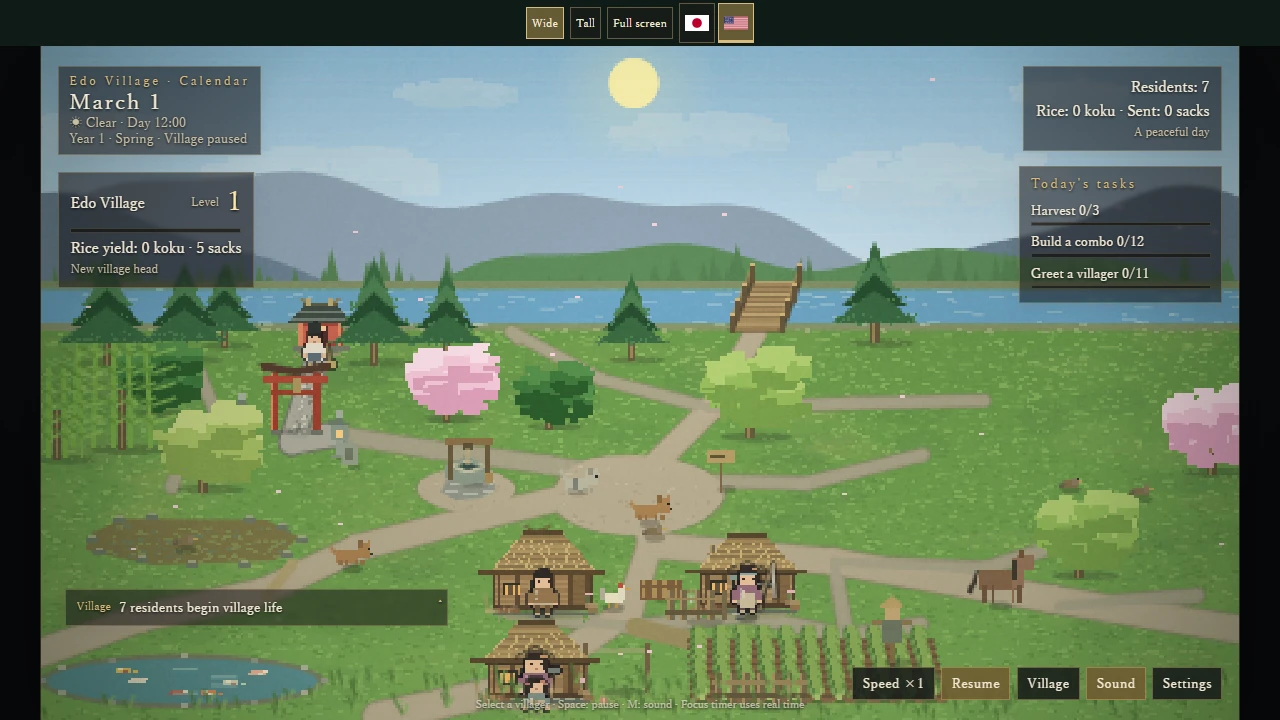
A farmer plants rice, children play, and lights appear in the houses as evening falls. When the seasons change, villagers gather for a festival. I wanted a small world like this beside me while working or taking a break. That was the starting point for Edo Mura.
I developed it through conversations with Codex, an AI tool that helps write and revise code. My part was deciding what kind of village I wanted to spend time in, then noticing what felt right or wrong on screen. I asked the AI to implement and check those ideas, tried the results, and kept refining them.
Begin with an ordinary day
The first specification covered an Edo-period farming village, changing seasons and weather, daily routines, and festivals. I also set out the browser format and screen layout.
What mattered was having something happening whenever I glanced at the screen. People leave home in the morning, work during the day, and return at night. That everyday rhythm became the foundation.
Let the settlement grow
The development system evolved from a village with its facilities already in place into a small settlement that grows. I wanted harvests to lead to new homes and fields, and new residents to arrive as the village expanded.
We worked through the conditions for construction, its progress, and housing capacity. Villagers visit a building site, a frame becomes a finished house, and someone moves in. New buildings also bring new work and places to go.
Give each resident small moments of life
Once the village was moving, individual lives became more interesting. Fishing, a conversation at the well, and a quiet tea break were joined by smaller gestures: petting a cat or playing hopscotch.
Homes gained details suited to their occupants, such as farming tools or fishing equipment. Residents' appearance and clothing change with age and season. We also added memories, so someone can meet a former fishing companion and recall their time together.
The villagers follow implemented rules. Layering gestures and relationships onto those rules helped them feel like people living in the village, rather than simply walking through it.
Turn what you notice into the next revision
The first result was rarely the final one. At a cherry blossom gathering, people stood too far from the trees. I asked for mats arranged around the blossoms, with roughly three people on each and others chatting nearby.
The focus timer changed from manually entered durations to selectable routines. Focus and breaks repeat automatically after starting, with sound alerts marking each transition. This made the village useful alongside work and study.
Checks included reopening saved villages, residents returning to daily life after festivals, and text and controls fitting portrait screens. Automated tests and visual checks worked together. Repeating this cycle was central to the project.
Bring the village into a trailer
The trailer combines actual gameplay, festival music, subtitles, and narration by Shikoku Metan from VOICEVOX. The title logo was made with image generation.
I checked that the footage matched the narration and that scenes were not repeated unnecessarily. Fishing appears alongside the fishing explanation, and rice planting alongside rice planting. The result was a trailer of about 27 seconds.
Music was created using Gemini, and sound effects used materials from Koukaon Lab. The aim was a world whose sounds, as well as its scenery, make it a welcome companion.
One scene at a time
Written specifications helped, but small requests made while looking at the screen were just as useful: brighten this scene a little, or have someone sit here. Each was another step toward the village I wanted to watch.
Edo Mura grew through that process of looking, noticing, and revising. Follow a resident, watch a seasonal gathering, or use the focus timer while working. I hope you find your own way to spend time in this small village.
This journal describes the making of the app. Visit the product page for its current features.